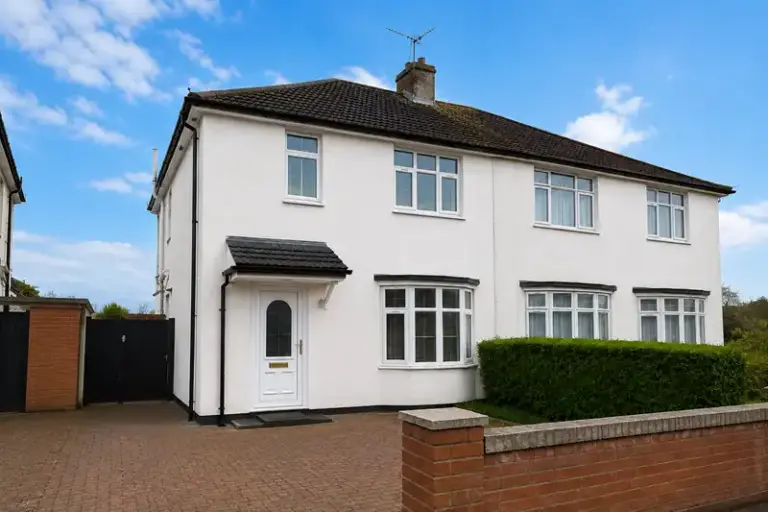
If you have searched for the best render cleaner, you have seen the shelves of products that promise to bring green walls back to white. Some of them do help. This is an honest guide to when a shop-bought render cleaner is enough, where it falls short and what a professional soft wash does differently.
Tried a render cleaner and the green came back?
Send us a few photos and we will tell you what your walls need.
The short answer: the best render cleaner is a biocide-based treatment applied evenly at low pressure. A shop-bought render cleaner can deal with a light green tint you can reach from the ground. For established algae, red or black staining and high walls, a professional soft wash is stronger, more even and lasts far longer.
What render cleaners actually are
Walk into a DIY store such as Screwfix or B&Q, or search online, and you will find plenty of products sold as render cleaners, algae removers and patio and wall cleaners. Most of them are biocides: they are designed to kill algae, mould and lichen, not to scrub them off. That is the right idea. Render should be treated, not blasted.
The difference between those products and a professional soft wash is not the principle. It is the strength, the way it is applied and what is left behind afterwards.
When a shop-bought render cleaner is enough
- The growth is light and recent, a faint green tint and nothing more.
- It is on a small area, such as a garden wall or the bottom of a house wall.
- You can reach all of it safely from the ground.
- You are happy to wait. These products usually work gradually over days or weeks.
In those cases, follow the instructions on the label, apply it evenly on a dry day and be patient.
Where shop-bought cleaners fall short
They are mild
The render cleaners sold in DIY stores are made for DIY use. They are designed to be safe for anyone to handle, so they are not as effective as the professional biocides we use. Light growth responds. Algae that has been established for years, red or orange staining and black streaks often do not, or only partly.
Even coverage is hard
Render is a big, flat, pale surface. Any patch that gets less product stays darker, and the wall ends up blotchy. Getting an even coat from a garden sprayer, across a whole elevation, is harder than it looks.
Height
Most staining is worst high up, under the roofline. That means working from a ladder leaned against the render, which marks the wall and is a serious fall risk.
No lasting protection
Once the product has done its work and weathered away, the wall is unprotected again, and the growth returns.
It is a story we hear often, on patios and driveways as well as render: a customer tries a DIY product first, is disappointed and then calls us. We look at the same question for paving in DIY pressure washer vs professional pressure washing.
What a professional soft wash does differently
- Professional biocide, which we buy from distributors recognised nationally and internationally, and choose for the type of render and the staining.
- A same-day result. The staining is gone the day we clean, not weeks later.
- Even application at low pressure, from the top of the wall to the bottom.
- Safe access to the whole wall, including under the roofline.
- A final treatment left in the render. It is absorbed into the surface, it is compatible with the render, and moisture in the air keeps it active, so algae, lichen and mildew cannot take hold for years.
The method is explained in soft wash render cleaning: how it works and why it lasts.
What never to use on render
- A pressure washer. See can you pressure wash render?
- Household bleach. It can discolour the finish and harm plants.
- Wire or stiff brushes. They leave permanent marks on a textured surface.
Does the type of render matter?
Yes. Always check that a product is suitable for your finish before you use it. Through-coloured renders are the least forgiving, which is why we cover them separately in K Rend cleaning. Pebble dash has its own difficulties too, covered in how to clean pebble dash.
So which should you choose?
Try a shop-bought cleaner if the growth is light, low down and recent. Call a professional if the staining covers a whole wall, is high up, includes red or black marks, has come back after a DIY treatment, or if the render is new and you want it protected properly. See why does new render go green so quickly?
See real results on our render cleaning in Bristol page, and our step-by-step guide on how to clean render. If you decide that you also need your gutters cleaned, please let us know when you book, so that we arrive with all the necessary tools. We will give you 50% off gutter cleaning alongside your render cleaning. Take your chance and let us know. Send us a few photos and we will tell you honestly whether a DIY product is likely to do the job.
More render cleaning guides
- Render cleaning cost: what affects the price?
- K Rend cleaning: how to remove green algae from K Rend safely
- How to clean render on a house: what works and what to avoid
- Soft wash render cleaning: how it works and why it lasts
- How to clean pebble dash and roughcast walls
- Why does new render go green so quickly?
- Why is my render turning green, red or black?
- Can you pressure wash render?
Render cleaners: frequently asked questions
What is the best cleaner for render?
A biocide-based treatment applied evenly at low pressure. It kills algae and mould at the root instead of trying to scrub or blast them off.
Do shop-bought render cleaners work?
They can work on light, recent green growth that you can reach from the ground. They are milder than professional treatments and struggle with established staining.
Can I use bleach to clean render?
No. Household bleach can discolour the render and harm plants below the wall. It is not a substitute for a proper biocide treatment.
Why has the green come back after I cleaned my render?
Because nothing was left in the render to stop it. A professional final treatment is absorbed into the surface and prevents regrowth for years.
Professional render cleaning in Bristol
Soft washing and a final treatment that keeps render clean for years.