

The final result depends on several factors, including the age of the stain, the type of surface and the cleaning method used. In this guide, we’ll explain what you should do immediately after an oil stain appears, which methods work in different situations and what results you can expect depending on the severity of the problem.
Do you have motor oil stains on your driveway and can't remove them?
We help you identify the most suitable cleaning method to remove oil stains from concrete, asphalt or block paving without damaging the surface.
What should you do immediately after noticing an oil stain?
The quicker you act, the better your chances of removing the stain completely. Motor oil doesn’t just stay on the surface. As time passes, it starts to soak into porous materials such as concrete or the joints between paving blocks, making the stain much more difficult to remove.
If the stain is fresh, your first goal is not to wash it straight away, but to prevent the oil from being absorbed deep into the surface.
Remove as much of the excess oil as possible using paper towels, old cloths or other materials that can absorb the liquid.
Cover the stain with an absorbent material such as cat litter, bicarbonate of soda or a specialist oil spill absorbent.
Leave the material long enough to absorb as much oil as possible before starting the actual cleaning process.
Remove the absorbent material and check whether there is still oil on the surface.
Pouring water over the stain immediately after noticing it.
Starting straight away with pressure washing without first removing the excess oil.
Scrubbing the surface aggressively before the oil has been absorbed.
Leaving the stain for a few days in the hope that it will disappear on its own.
Is the stain fresh or old?
Before choosing a cleaning method, it is important to work out how long the oil has been on the surface. This affects how easily the stain can be removed and how good the final result will be.
In general, fresh stains are much easier to treat than those that have had time to penetrate deep into the surface.
- It usually has a wet or shiny appearance.
- It is mostly on the surface of the material.
- It has not had enough time to penetrate deep into concrete, asphalt or the joints between paving blocks.
- It responds better to absorbent materials and standard cleaning methods.
- It usually has a darker colour and a dry appearance.
- It has already been absorbed into the surface.
- It may remain visible even after one or more cleaning attempts.
- It often requires stronger degreasers and several successive treatments.
Concrete, asphalt and many types of paving are not completely impermeable. Over time, oil penetrates the pores of these materials and can no longer be removed only from the surface.
For this reason, cleaning an old stain often involves extracting the oil from within the surface, not just washing it.
It is important to have realistic expectations as well. In the case of fresh stains, the surface can return almost to its original appearance after cleaning. In contrast, old or very deep stains can sometimes leave visible marks even after proper cleaning. This does not necessarily mean that the process has not worked, but that some of the oil has penetrated deep into the material.
How does the type of surface affect the cleaning process?
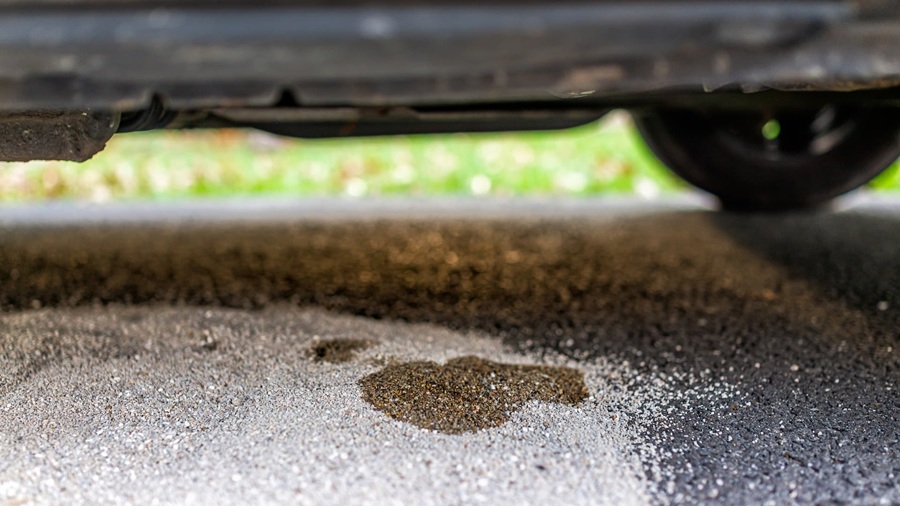
Not all driveways react in the same way when they are stained with oil. The level of absorption of the surface can affect both the difficulty of the cleaning process and the final result. For this reason, the same method may work very well on one surface and less on another.
Oil stains on concrete
Concrete is one of the most porous surfaces found on driveways. For this reason, oil can penetrate the material relatively quickly, especially if the stain is not treated in time.
In the case of concrete:
- Oil can penetrate deep into the surface.
- Old stains are more difficult to remove completely.
- Degreasing plays an important role before any other cleaning method.
- Several treatments may be needed to achieve a good result.
Oil stains on asphalt
Asphalt is different from concrete and requires more care during cleaning. Some strong degreasers or aggressive methods can affect the appearance of the surface.
In the case of asphalt:
- It is recommended to test products on a small area before use.
- Excessive pressure can damage the surface.
- Gentler methods are generally a safer choice.
- Cleaning should be carried out without affecting the top layer of the asphalt.
Oil stains on block paving or other paved surfaces
Oil stains do not always remain only on the surface of the paving blocks. They can also penetrate the joints between them, which can complicate the cleaning process.
In the case of paved surfaces:
- Oil can be absorbed by both the paving blocks and the joints.
- Cleaning may take more time than on a continuous surface.
- Repeated treatment of the affected areas is sometimes necessary.
- Old stains may remain visible, especially in areas where the oil has penetrated deep between the paving blocks.
How can you remove oil stains from a driveway?
After you have absorbed the excess oil and assessed the age of the stain, you can move on to the actual cleaning process. In many situations, the same basic method works regardless of the surface, but the results may vary depending on how deeply the oil has penetrated.
- 1.
Before applying any product:
- Remove the absorbent material used earlier.
- Sweep the area to remove dirt, dust and other debris.
- Make sure the surface is accessible and that the stain is completely visible.
A clean surface allows the chosen product to come into direct contact with the oil.
- 2.
Choose a degreaser or a solution suitable for the type of surface and follow the manufacturer’s instructions.
In general:
- Apply the product directly to the stain.
- Cover the entire affected area.
- Avoid excessive dilution if the product is designed for difficult oil stains.
The purpose of this step is to dissolve and loosen the oil from the surface.
- 3.
Many homeowners skip this step, but the contact time is essential.
- Follow the time recommended by the manufacturer.
- Do not remove the product immediately after application.
- In the case of older stains, a longer contact time may be necessary.
This period allows the degreaser to penetrate and break down the oil deposits.
- 4.
After the product has had time to work:
- Use a stiff-bristled brush.
- Scrub the entire stained surface.
- Pay attention to the areas where the oil appears to be more concentrated.
- Avoid tools that can damage the surface.
Scrubbing helps to loosen the oil that has started to rise from the pores of the material.
- 5.
After cleaning:
- Rinse the area thoroughly with water.
- Remove any remaining residue.
- Allow the surface to dry completely before assessing the result.
A stain may appear to have disappeared when the surface is wet, but it can become visible again once it has dried.
- 6.
In the case of old or deeply absorbed stains:
- A single cleaning may not be enough.
- Several successive treatments may be necessary.
- The results often improve from one application to the next.
If you are not sure about the next step, the GB Cleaning team can help you identify the most suitable cleaning method depending on the type of material, the age of the stain and the level of absorption.
What products can help remove oil stains?
There is no single solution that works in every situation. Choosing the right product depends on the age of the stain, the type of surface and the amount of oil that has penetrated the material.
Absorbent solutions
Absorbent materials are most useful immediately after a spill occurs, as they can reduce the amount of oil that reaches deep into the surface.
Among the most commonly used options are:
- Cat litter
- Bicarbonate of soda
- Sawdust
- Specialist oil spill absorbents
These products do not clean the stain itself, but they can absorb a significant amount of the oil before it becomes absorbed into the surface.
Degreasers and specialist products
For stains that have already formed, degreasers are usually the most effective option.
Their advantages are:
- Break down oil deposits more effectively than water alone.
- Can penetrate the pores of the surface.
- Are specially designed for oil and grease contamination.
However, it is important to choose a product that is compatible with the type of surface and to follow the manufacturer’s instructions. A very aggressive degreaser can affect certain materials, especially asphalt.
Household solutions
If the stain is recent or not very severe, you can also try a few solutions that many homeowners already have to hand.
The most commonly used are:
- Washing-up liquid
- Bicarbonate of soda
- Hot water
- Vinegar (in certain situations)
These solutions can help reduce surface stains, but the results are generally limited in the case of old stains or very porous surfaces.
- It's important to remember that DIY solutions work best when the stain is fresh.
- If the oil has had time to penetrate deep into the surface, you may need specialist products or more advanced cleaning methods.
Can pressure washing remove oil stains?
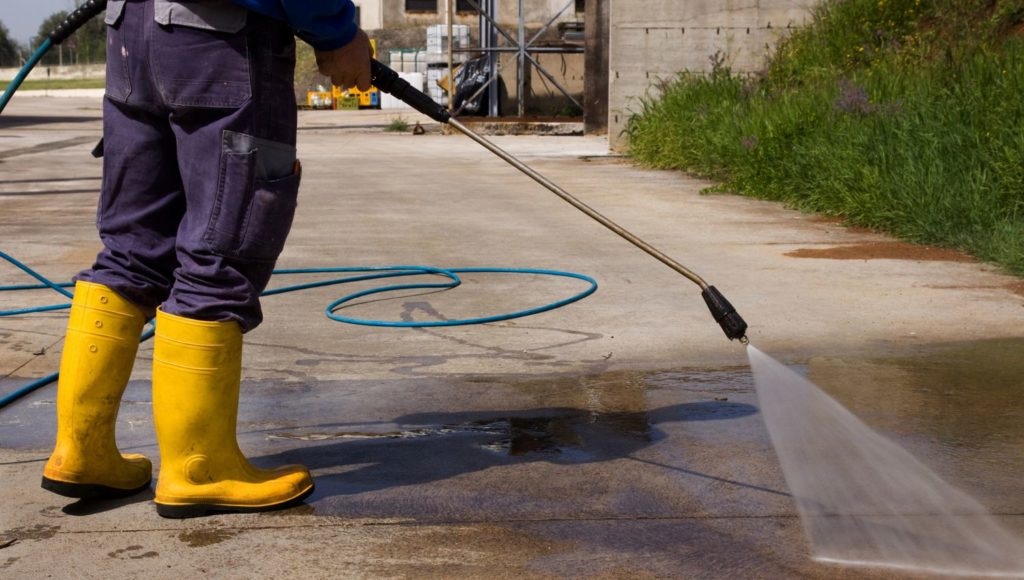
Pressure washing can be useful for removing oil stains, but the results depend on the age of the stain and how deeply the oil has penetrated the surface. In many cases, it works best as part of the cleaning process, not as the only method used.
Pressure washing is usually effective when:
- The stain is relatively recent.
- The oil has not penetrated very deeply into the surface.
- A suitable degreaser has been applied beforehand.
- The aim is to remove any residue left after treating the stain.
It can also help to clean a larger surface affected by dirt, dust and other deposits that often accompany oil stains.
A common mistake is to use only pressure washing immediately after noticing the stain.
The problem is that a pressure washer can remove some of the contamination from the surface, but it does not dissolve the oil that has already penetrated the pores of the material. In some situations, the water can even spread the contamination over a larger area.
For this reason, degreasing is usually an important step before using a pressure washer.
Degreasers are designed to break down and loosen the oil from the surface.
In most cases, the correct process is:
- 1. Applying a suitable degreaser.
- 2. Following the contact time.
- 3. Scrubbing the surface.
- 4. Rinsing with water or pressure washing.
This combination usually provides better results than using only water under pressure.
Although pressure washing can be effective, using too much pressure can cause problems.
Among the most common risks are:
- Damage to asphalt.
- Damage to the joints between paving blocks.
- Removal of the material between the paving blocks.
- Marking or damaging certain sensitive surfaces.
For this reason, the pressure should be adjusted according to the material being cleaned.
If you have already tried to clean the stain using degreasers and a standard pressure washer, but the results are limited, a different approach may be needed.
At GB Cleaning, we often come across situations where oil stains have remained on the surface for months or even years. In these cases, the difference is not only the water pressure, but also choosing the right equipment, the products used and the method of application.
For this reason, in the case of difficult stains, professional cleaning can provide better results than simply repeating the same methods used at home.
What should you do if the stain does not disappear completely?
If the stain is still visible after the first cleaning, it does not necessarily mean that the process has failed. In many cases, several treatments are needed to achieve a better result.
You can try the following steps:
- Repeat the cleaning process using the same method or a more effective degreaser.
- Leave the product long enough before scrubbing and rinsing.
- Check the result after the surface has dried completely.
- Avoid using aggressive products or methods that could damage the surface.
How can you prevent new oil stains from appearing?
Although not all leaks can be prevented, a few simple measures can significantly reduce the risk of new oil stains appearing on your driveway.
- 1.
Many stains appear because of minor leaks that go unnoticed for a long period of time.
It is recommended that you check regularly:
- The area underneath the car after parking.
- Any traces of oil in the parking space.
- Signs of leaks around the engine or underneath the vehicle.
- 2.
If you notice that the vehicle is leaking oil, putting off the repair can lead to new stains appearing and the gradual deterioration of the surface.
A quick repair is usually simpler and less costly than repeatedly cleaning the driveway.
- 3.
If you know that the vehicle has a temporary leak or is prone to this type of problem, you can use:
- Oil drip trays.
- Protective mats for the parking area.
- Other solutions that prevent the oil from reaching the surface directly.
- 4.
The sooner you act, the greater the chances that the oil will not penetrate the surface.
Even a small amount of oil is easier to deal with in the first few minutes than after several days or weeks.
- 5.
On certain surfaces, a sealer can reduce the level of absorption and provide additional protection against stains.
However, its effectiveness depends on the type of driveway and the condition of the surface, which is why it is important to choose a product that is compatible with the existing material.
Have you tried to remove the stain but without success?
Some oil stains can be removed relatively easily, but old stains or those that have penetrated deep into the surface may require a different approach. If you have already tried several methods and the results are not what you expected, the GB Cleaning team can help you identify the most suitable solution for your driveway.
Rather leave it to the professionals? See our patio and driveway cleaning service in Bristol for oil stains, weeds and block paving re-sanding.
