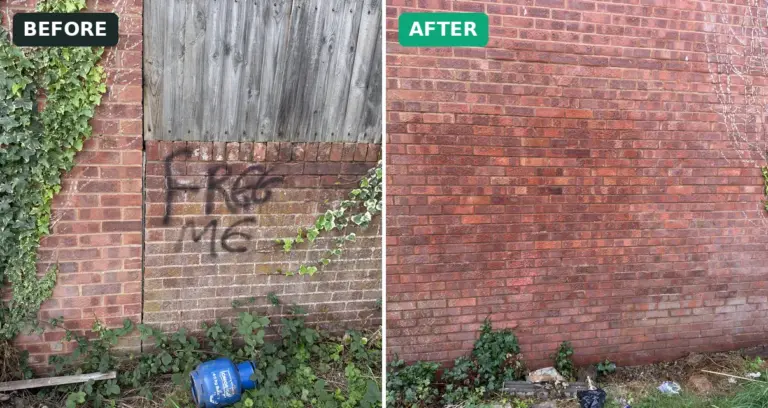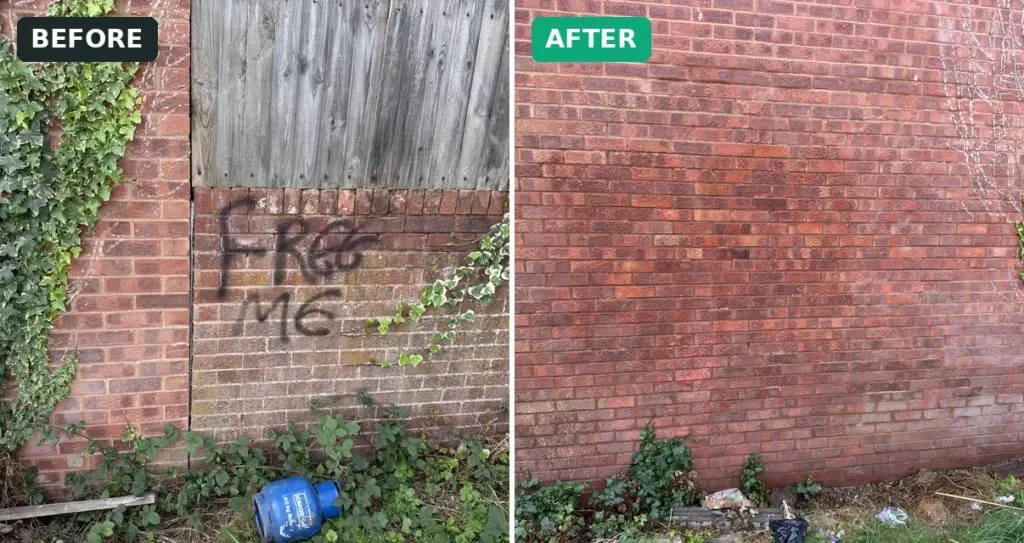
How many types of graffiti paint are there, and why do some wash off while others seem to be part of the wall? Here are the six main types, what each one contains, and how hard each one is to remove.
Graffiti on your wall?
Send us a photo of the graffiti and the surface for a free quote.
The short answer: there are six main types of graffiti paint. Chalk and water-based paints are the easiest to remove, standard spray paint sits in the middle, and marker inks, two-pack paints and bitumen-based sprays are the hardest. The type of paint, the surface and the age of the graffiti decide how many washes are needed.
Why the type of graffiti paint matters
From the pavement, all graffiti looks the same. Up close, it is not. Every graffiti paint is a mix of colour (pigment or dye), something that makes it stick (the binder) and something that makes it flow (the solvent). Change that recipe, and the paint behaves very differently when you try to remove it.
That is why one tag is gone after 2 or 3 washes, while the one next to it needs 6. It is also why graffiti removal prices vary from one job to the next.
The 6 types of graffiti paint, from the easiest to the hardest to remove
- 1. Chalk, chalk spray and water-based craft paintsEasiest to remove
What it contains: chalk or pigment mixed with water, with little or no binder.
Why it is easy to remove: nothing holds the colour in the surface. On most surfaces it is gone in the first wash.
- 2. Standard graffiti spray paintUsually easy
What it contains: pigment, an organic binder such as an acrylic or alkyd resin, solvents and a propellant. This is the ordinary graffiti spray paint sold in cans, and most graffiti is made with it.
Why it is easy to remove: a professional graffiti remover softens the binder, and heat lifts the paint out. On hard surfaces it often comes off in 2 or 3 washes. Old paint, and strong red or black pigments, can take longer.
- 3. Household paint applied by brush or rollerMedium
What it contains: the same kind of binders as spray paint (emulsion or oil-based gloss), but applied in a much thicker layer.
Why it is hard to remove: the layer is thick, so it takes more passes to get through it. The good news is that much of it sits on the surface rather than deep inside it.
- 4. Marker pens and inksHard to remove
What it contains: dye in a water or solvent carrier, with little or no binder. Permanent markers and paint markers belong here.
Why it is hard to remove: the ink is thin, so it soaks deep into porous surfaces such as brick, stone, render and wood. It wipes off glass and metal quite easily, but on porous surfaces it is the type most likely to leave a shadow behind.
- 5. Two-pack, polyurethane and epoxy paintsVery hard to remove
What it contains: resins that cure chemically into a hard film. Engine, appliance and some car paints are of this type.
Why it is hard to remove: once it has cured, the film resists ordinary solvents. It needs stronger graffiti remover chemicals and more washes.
- 6. Bitumen-based spray and undersealHardest to remove
What it contains: bitumen, the black, tar-like material used to underseal cars.
Why it is hard to remove: it is sticky, it soaks into the surface, and it becomes more resistant to heat and solvents as it ages. It is one of the most stubborn types of graffiti there is.
One more kind is worth knowing about, although it is not paint at all. Graffiti that has been scratched or acid-etched into glass has damaged the surface itself, so no graffiti cleaner can wash it off.
The surface matters as much as the paint
The same paint behaves differently on different surfaces. Brick, stone, concrete, metal and glass can take a little more pressure, so on these surfaces we repeat the treatment until the graffiti has been removed 100%.
Render and wood are another matter. They are porous and easily damaged, so the pressure has to stay low, and the number of washes is limited. We always do our best, and in many cases the graffiti comes off completely, but we never promise 100% on render or wood. When it does not all come out, 90% to 98% is removed and a faint shadow, known as ghosting, can remain.
Age matters too
Fresh graffiti is easier to remove than old graffiti. The longer the paint stays, the deeper it sinks and the harder it sets. If you have just found graffiti on your wall, do not wait: it will never be easier to remove graffiti than it is today.
How we remove every type of graffiti
The method is the same for all six types. Only the number of washes changes.
- First, we apply industrial graffiti remover chemicals, which break the paint down.
- Then we clean the surface with DOFF cleaning, which is low-pressure steam at up to 150°C.
- Whatever is left is treated and cleaned again. The easier paints are gone in 2 or 3 washes, and the hardest ones can need up to 6.
You can see the full process, and a real job on a brick wall in St Pauls / Montpelier, on our graffiti removal in Bristol page.
If the same wall is hit again and again, an anti-graffiti coating can make every future clean quicker. We apply it only on request, as a separate service.
Our aim is not to have the lowest prices, but to deliver the best quality service for the price that you pay.
Types of graffiti paint: FAQs
What are the main types of graffiti paint?
There are six: chalk and water-based paints, standard spray paint, household paint applied by brush or roller, marker inks, two-pack paints such as polyurethane and epoxy, and bitumen-based sprays.
Which graffiti is the hardest to remove?
Bitumen-based spray is one of the most stubborn types, followed by two-pack paints and by marker ink on porous surfaces. These can need up to 6 washes with industrial graffiti remover chemicals and steam.
Why does a shadow stay behind after graffiti removal?
A shadow, or ghosting, is colour that has soaked deep into a porous surface. It is most likely with marker inks and with strong red or black pigments, and on sensitive surfaces such as render and wood.
Does fresh graffiti come off more easily?
Yes. Fresh paint has had less time to sink in and harden, so it usually needs fewer washes than old graffiti.
What is the best graffiti cleaner?
No single graffiti cleaner works on every paint and every surface. That is why we pair an industrial graffiti remover, which breaks the paint down, with low-pressure steam, which lifts it out.
Graffiti removal in Bristol and Bath
Industrial graffiti remover and DOFF steam cleaning, with same-day response for emergencies.